
Agreement is easy to overestimate
A strategy is presented. Heads nod. Nobody objects. The meeting ends with apparent agreement.
Then the organization starts executing.
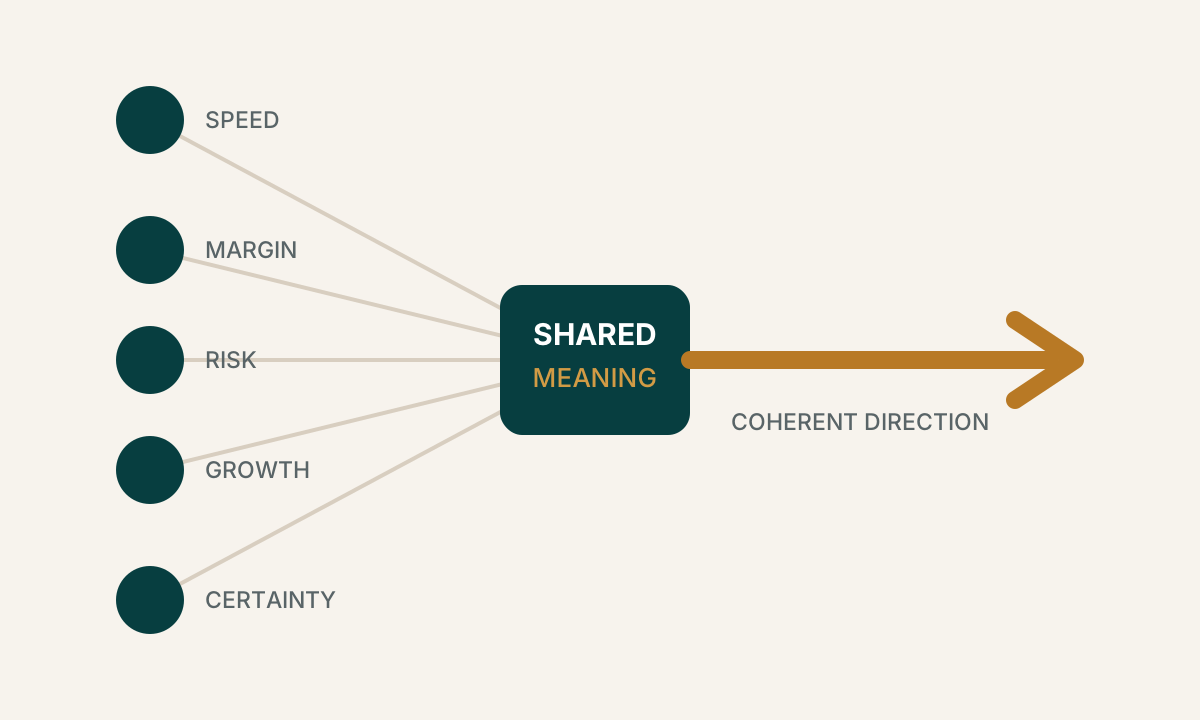
One leader treats speed as the priority. Another protects margin. A third waits for more certainty. One business unit interprets the change as a technology program while another treats it as an operating-model redesign. Functions make rational decisions from different assumptions, and the organization experiences the inconsistency as confusion.
Alignment requires shared operational meaning
Leadership alignment is not the absence of disagreement. It is the presence of enough shared meaning that people can make consistent decisions after the meeting is over.
That means leaders should be able to explain the intended outcome in compatible language, name the critical tradeoffs, clarify what will stop as well as what will start, identify who owns the major decisions, and reinforce the same priorities when pressure arrives.
McKinsey’s 2026 transformation research describes a related problem as collective action: leaders may share a stated goal while local interests, information gaps, incentives, or ownership patterns pull behavior in different directions. The answer is not more slogans. It is a management system that links targets, ownership, trajectory, incentives, and transparent progress.
Surface consensus can hide a real gap
BCG’s recent work on CEO-board AI alignment illustrates how easily this happens. Leaders can appear aligned on governance, implementation, and value creation while holding materially different understandings of what the technology can do, how fast value should appear, and what risks matter.
The same pattern exists inside executive teams. Agreement on the headline can coexist with disagreement on the meaning.
A practical alignment test
Before declaring a leadership team aligned, ask each leader to answer the following separately:
- What outcome are we trying to produce?
- What are the three most important priorities for the next 90 days?
- What tradeoff are we willing to make to protect those priorities?
- What decisions can teams make without coming back to us?
- What behavior from leaders would contradict the change?
- What will we measure to know the change is working?
If the answers are materially different, the issue is not communication downstream. The alignment work is unfinished upstream.
Alignment becomes visible in reinforcement
The strongest test is what happens after the meeting.
Do leaders fund the same priorities? Do they make compatible decisions? Do they resolve cross-functional conflicts using the same logic? Do incentives reinforce the stated direction? Do they protect the change when short-term pressure arrives?
Alignment that exists only in a presentation is not alignment. It is temporary agreement.
The work of leadership is to hold the direction
Organizations do not need leaders to repeat identical words. They need leaders to hold a coherent direction.
That requires clarity about the outcome, shared decision logic, explicit ownership, and visible reinforcement. Once those conditions exist, the organization can move without waiting for leadership to re-explain the strategy at every turn.
Leadership alignment is not everyone saying yes. It is the organization being able to move as though the leaders mean the same thing.
Make alignment operational
If your leadership team agrees on the strategy but execution still fragments, Peloton Consulting can help clarify the decisions, tradeoffs, ownership, and reinforcement required for the organization to move coherently.
Start a Conversation →