
The pilot is not the hard part anymore
Most organizations can now prove that an AI tool can perform a task. A team can generate a summary, draft code, classify a document, automate a support interaction, or accelerate an analysis. That proof matters. But it answers a narrow question: can the technology do something useful?
The larger question is whether the organization can turn that capability into a repeatable operating result. That is where many programs stall.
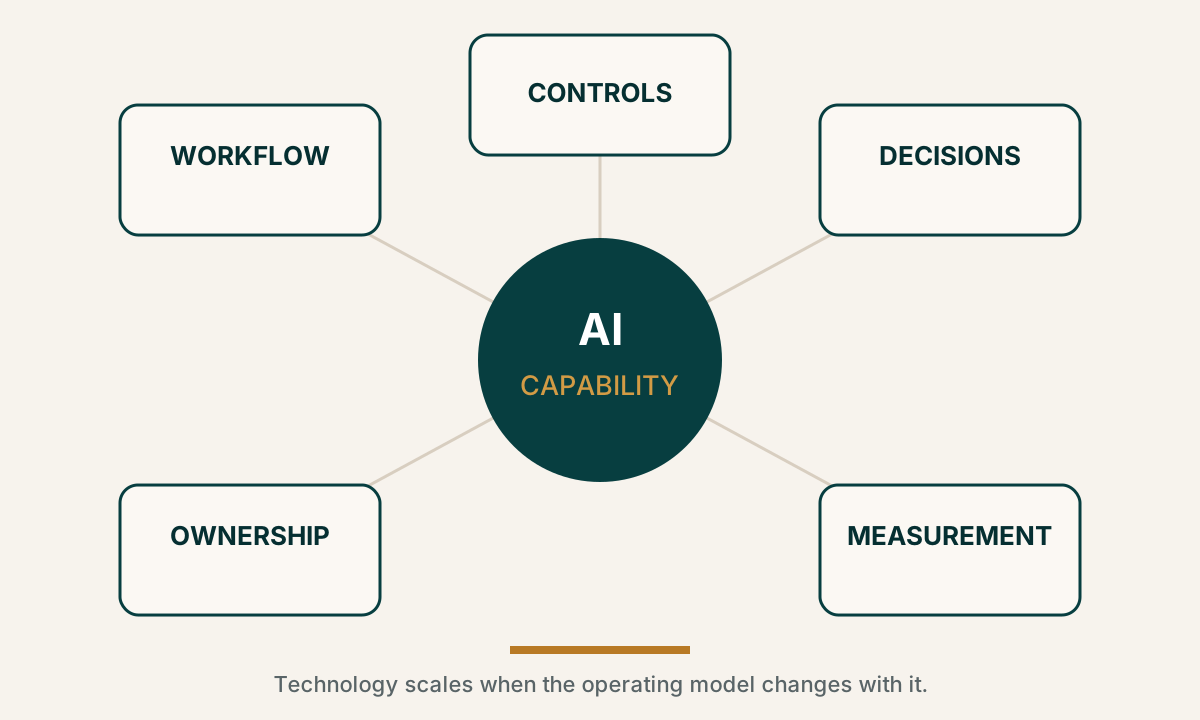
Recent research points to the same pattern. Gartner has warned that AI activity is scaling faster than outcomes when organizations leave the operating model largely untouched. BCG reports that many companies remain trapped in pilots and incremental automation, while the organizations capturing meaningful value are redesigning end-to-end processes around AI-enabled decisions. Deloitte makes the same distinction: experimentation can build confidence, but scale depends on rethinking processes, controls, data, roles, and skills around the work.
Model performance is not operating performance
An AI system can perform well inside a controlled use case and still create disappointing enterprise results. The reason is simple: the model does not own the surrounding workflow.
It does not decide who is accountable when the recommendation is wrong. It does not resolve a dispute between functions. It does not determine whether a control should happen before or after an automated step. It does not rewrite incentives that reward local efficiency while damaging end-to-end performance. It does not remove the approval that was unnecessary before AI and becomes even more expensive after AI makes everything upstream faster.
When those conditions remain unchanged, the organization can automate activity without redesigning performance. In some cases, it simply makes an old process move faster toward the same bottleneck.
Five operating-model questions to answer before scaling
Before asking how many use cases can be deployed, leadership should be able to answer five more practical questions.
- What business outcome is this workflow supposed to produce? If the answer is a task metric rather than an operating result, the initiative may be optimizing the wrong level.
- Who owns the value? Technology can enable the change, but ownership for business results must sit where the result is created and measured.
- What decisions change? AI usually changes the speed, frequency, or quality of information. That means decision rights, escalation paths, and human override rules often need to change with it.
- What work should disappear? If AI is only added to the existing process, complexity tends to survive. The better question is which steps, handoffs, checks, or roles are no longer necessary.
- What will prove that value is real? Logins, copilots deployed, use cases launched, and hours theoretically saved can all be useful operating signals. None of them proves that cost, revenue, cycle time, quality, risk, or customer outcomes improved.
Measure the system, not the novelty
The number of pilots is a poor transformation scorecard because pilots measure experimentation. Leaders need measures that show whether the operating system changed.
Useful evidence can include cycle-time reduction across the full workflow, fewer handoffs, fewer exceptions, lower cost-to-serve, reduced rework, improved decision speed, better forecast accuracy, improved customer outcomes, or financial value that can be traced through the business.
The exact measure depends on the work. The principle does not: measure the result the organization exists to produce, not the excitement generated by the technology.
The executive next step
When AI initiatives are producing activity but not enough value, the reflex is often to add more training, more tools, or more use cases. Sometimes those are needed. But first, examine the system around the technology.
Map the work end to end. Identify the decisions that matter. Clarify ownership. Remove steps that no longer make sense. Decide where human judgment must remain explicit. Then measure whether the redesigned workflow is producing a better business result.
AI does not fix a broken operating model. It makes the consequences of that operating model easier to see.
Start with the operating model around the technology
If AI activity is scaling faster than business value, Peloton Consulting can help leadership clarify where work, decisions, ownership, and measurement need to change before the next wave of scaling.
Start a Conversation →