
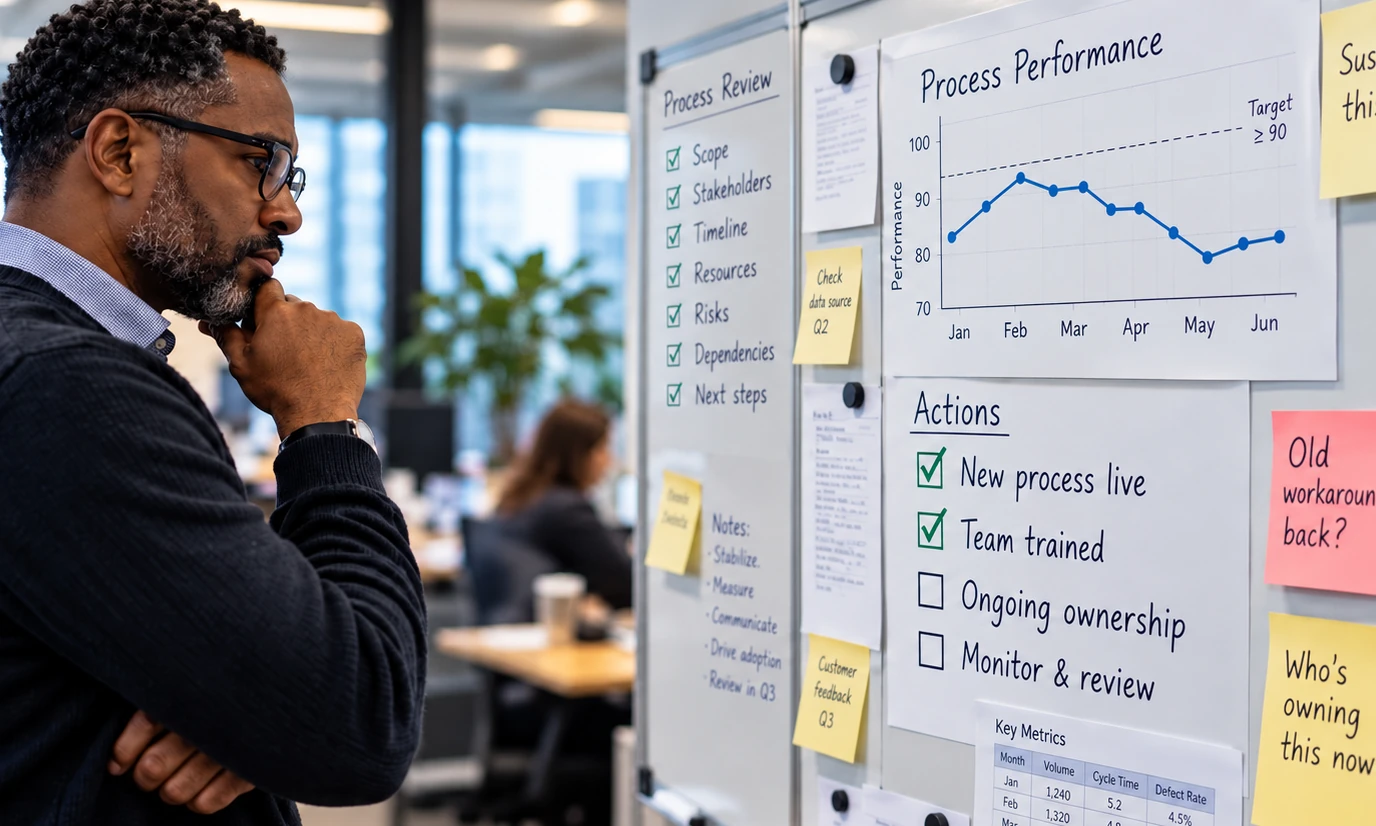
A successful launch is not the same as a lasting improvement
Organizations put a great deal of energy into getting change across the finish line. They design a process, configure a system, train employees, celebrate the launch, and close the project. Then everyday pressures take over.
When performance slips, the explanation is often that people resisted change. Sometimes they did. But that conclusion can miss the more useful question: what made the new way of working sustainable, and what happened to that support after the project team left?
The old way still has an operating advantage
People return to familiar methods when those methods are quicker, better supported, or more compatible with the incentives around them. A new process may require a field that nobody supplies, an approval that takes too long, or a report that managers never use.
In that situation, training the same people again is unlikely to solve the underlying problem. The organization has introduced a new process without changing the conditions that shape daily decisions.
The formal workflow is the documented sequence of steps and approvals the organization expects employees to follow. The practical workflow is how people actually complete the work when those steps do not fit real conditions. A report may show that the task was completed without showing the extra handoffs or workarounds required. Leaders see a compliant result while employees experience a process that needs constant improvisation. Eventually the process on paper and the process on the floor are no longer the same.
Ownership cannot end with the project
Someone needs to be responsible for whether the improved process remains useful. That responsibility is not the same as managing a temporary implementation plan. A durable process owner monitors performance, resolves exceptions, approves adjustments, and notices when the work begins to drift.
The owner must also have usable authority. Assigning accountability without decision rights, staff time, or management attention turns ownership into just a label.
- Who can change the process when circumstances change?
- Which measures reveal deterioration early, rather than after customers complain?
- What happens when the new process conflicts with an urgent operational priority?
- Who coaches new employees after the original training team disappears?
Practice must continue after the class ends
Training has a shelf life when employees cannot use what they learned. I have seen people complete training and then wait a quarter or longer to work in the live system. By then the lessons had faded. Practice close to launch matters, but so does ongoing access to experienced colleagues who can coach people through unfamiliar situations.
Designated subject-matter experts can help keep that knowledge alive. Give them time to master the work, teach it to their peers, check for understanding, and offer a different explanation when the first approach does not land. Connect proficiency to meaningful development expectations and recognize the additional contribution. Most of all, keep instructions and recovery guidance close to the actual work rather than leaving them in a training folder.
Reinforcement belongs in everyday management
Lasting improvements are sustained through normal operating routines. Supervisors need a practical way to spot exceptions, employees need a path to report problems, and leaders need to reinforce the choices they say matter.
A weekly discussion of rework or cycle time may be more valuable than another launch presentation. People also need to recognize themselves in the measures. On some engagements, I have shared anonymized performance results, without employee names or identifiers, to make the team's progress visible. People started asking questions and taking a closer interest in the results. The point was to create a shared understanding, not to single anyone out.
Ownership grows further when employees help build the process. For work spanning multiple regions, I have mapped each location's way of operating and brought the people doing that work together to compare practices. One region might demonstrate a particularly effective approach while another explains which local conditions would prevent it from working there. The group can then design a common approach, define necessary exceptions, agree on accountability, and decide what to measure. The process becomes something they helped create rather than something handed down to them.
A clearly documented decision rule may do more than an elaborate communications campaign. The useful question is whether reinforcement occurs where the work happens.
Make adaptation part of the design
The business will not stand still. Customers change, volume changes, employees leave, and systems evolve. A process that cannot adapt will eventually generate workarounds, even if it was well designed on launch day.
Instead of asking why employees abandoned the improvement, ask what the current operating conditions are rewarding. Fix those conditions, maintain visible ownership, and treat sustainment as part of the original work, not an optional follow-up.
Decide who inherits the improvement
A launch team can leave behind training materials and a polished process map. Somebody still has to notice when new employees struggle, policy changes, or an exception becomes the rule. Agree on the person, time and authority that work requires before the project ends. Explore how change reinforcement fits the operating work.
Start a Conversation →Free practical resource · No signup required
Operational Friction Check
A two-page worksheet with room to record where work stalls, why, and what to test next.